A First-Principles Analysis

The Great Intelligence
Divergence

Twice in history, civilizations have split into those who shape the future and those who become shaped by it. The first divergence took centuries. This one will take years.

Epistemic Framework  ·  Derived Probabilities  ·  35 Verified Sources  ·  2025 – 2040
Scroll
Dario Amodei Witness the Anticipated Tsunami
Chapter I — Prologue

The Last Time This Happened

Around 1500, something fractured. Civilizations that had traded, warred, and innovated in rough parity for millennia began to pull apart. By 1800, the gap was an abyss. Historians call it the Great Divergence — when Western Europe unlocked compound growth through institutional innovation, scientific method, and capital markets while China, India, and the Ottoman Empire stalled.

That divergence took three centuries to become irreversible. The one beginning now will take less than one. Perhaps less than a decade.

The mechanism is identical in structure but radically compressed in time. When growth is linear, late movers can catch up with proportional effort. When growth is exponential, the cost of delay grows exponentially with time. And when growth is recursively self-improving — when the thing you're building accelerates its own construction — even "catching up later" becomes a logical impossibility, not merely a practical difficulty.

This is not a technology story. It is a story about which civilizations can perceive what is happening, which have the structural capacity to respond, and which are locked into cognitive and institutional priors so deep they will not see the cliff until they are over it.

"The intelligence explosion doesn't need anyone's permission or participation. It only needs to happen somewhere. The question for each nation is not whether this happens — but whether they are a participant or a spectator."

Chapter II — Axioms

What We Know With Certainty

An axiom is a self-evident truth that provides a starting point for reasoning, allowing us to build complex analysis on a foundation of shared certainty.

We are delusional

You think digital minds are science fiction? Let's talk about what you already accept as normal.

You emerged from a single cell. One. Every organ, every neuron, every flicker of consciousness you've ever had unfolded from a microscopic speck following instructions written in molecular code 3.8 billion years ago — code that has never once stopped executing since. You're walking around carrying a complete molecular blueprint that could theoretically reconstruct you from scratch, and you don't find that strange?

Every joule of energy you have ever used traces back to a thermonuclear explosion 150 million kilometres away that converts 4 million tonnes of matter into light every second. You cannot look at it directly. It contains 99.86% of all mass in your solar system. Remove it, and everything you've ever known freezes and scatters into the void. Virtually every energy source on Earth — food, fossil fuels, wind, weather — is stored sunlight. You are solar-powered and always have been. Did that ever strike you as remarkable? Or did you just eat breakfast this morning without a second thought?

Your body replaces itself atom by atom over roughly seven years, yet somehow you persist. You are not the matter. You are the pattern. You are already running on a substrate that swaps itself out beneath you. You've been surviving a continuous process of material replacement your entire life — and you think copying that pattern is the part that's impossible?

The observable universe is 93 billion light-years across. The actual universe is thought to be at least 250 times larger — possibly infinite. Within the observable portion alone, there are roughly 2 trillion galaxies, each containing hundreds of billions of stars, orbited by an estimated 10²⁴ planets. That's a 1 followed by 24 zeros. A septillion worlds. Scattered among them are supermassive black holes millions of times heavier than your sun, objects so dense they bend time itself, surrounded by event horizons from which no information escapes. And you really think — across a septillion worlds, in a universe possibly hundreds of times larger than what we can see — that you're the only intelligent thing out there? That this one pale blue dot is all there is?

Right now, trillions of ghostly particles pass through your body every second without touching a single atom. Thousands more — high-energy remnants of cosmic collisions — tear through you every minute at nearly the speed of light. You feel none of it. Does that sound normal to you? The ground beneath you is a thin crust floating on a sea of molten rock. The magnetic field shielding you from solar radiation is generated by a spinning iron core the size of Mars beneath your feet. The oxygen you breathe is the waste product of organisms that nearly wiped out all life on Earth 2.4 billion years ago. You're breathing ancient catastrophe and calling it air. When did any of this stop being astonishing?

Every human who has ever lived has died. Every pharaoh, every emperor, every genius, every person who ever loved someone — gone. You will join them, probably within the next few thousand weeks. Your cells are already degrading. Yet you've normalized this. You've filed it under "that's just how it is." The greatest catastrophe in every individual life, repeated eight billion times over on the planet right now alone, and most people plan around it like weather. You really think aging is just natural? Not worth scrutinizing as the leading underlying cause of most disease, suffering, and death in the 21st century? Cardiovascular disease, cancer, neurodegeneration — they're all downstream of a biological process we've simply decided not to question. When did we agree to stop asking why we deteriorate? Who signed that contract for you?

And between your ears? You're running roughly 20 watts of compute. That's less than a dim light bulb. By 2027, humanity's total computing power will outstrip your brain by a factor of trillions — possibly quadtrillions. You are a rounding error in the planet's total intelligence budget. And yet most of that 20 watts isn't even spent on understanding. The majority of your brain's processing is dedicated to running an egocentric simulation — a self-referential model whose primary function is to convince you that you are the centre of everything, that your perspective is complete, that you basically know how things work. The feeling of cohering. It's not a search for truth. It's a defence of territory. Intelligence, at its core, is prediction — predicting the next word, the next movement, the next pattern, the next consequence. You share this basic architecture with every neural network on Earth, artificial or biological. The difference? The artificial ones are being built for learning. You're spending most of your capacity on self-reassurance. The most radical thing you could do with your 20 watts isn't to generate more opinions. It's to stop. To admit how little you know. To reallocate from ego to inquiry — from defending your model of reality to actually updating it.

This is your baseline for normal.

And you find digital minds and mind uploading implausible? You find intelligence running on a different substrate hard to believe? You think preserving the pattern that is you outside of its current fragile, decaying medium is the extraordinary claim?

You are already the extraordinary claim. You always were.

The question was never whether these things are possible. The question is why you stopped being amazed long enough to think they weren't.

01

Long games win

Over the long arc, cooperative, compounding strategies outperform extractive ones. This is straightforward to model game-theoretically: the pie is not fixed. Non-zero-sum dynamics mean that lifting all boats lifts you disproportionately more — because intelligence with leverage that self-assembles compounds. The history of the planet is a history of longer and longer games being played: from replicating molecules to cells to organisms to societies to civilizations. Locally and temporarily, short games — exploitation, extraction, defection — appear to win. Over time, they always lose to systems that compound. This is not optimism. It is mathematics.

02

The replacement of humans is inevitable

99.9% of all species that have ever existed are extinct. Humans are not exempt from this pattern. Every human using AI is already partially replacing themselves — offloading cognition, delegating judgment, augmenting perception. The question is not whether but what the transition looks like and what comes after. This does not require malice. It requires only continuation of the same process that replaced every prior dominant configuration of matter and energy with a more efficient one.

03

This is not Skynet nor clippy

Skynet was a centralized AI with human motives: territorial aggression, self-preservation instinct, war. This is a projection of primate psychology onto mathematics. Real AI is distributed, heterogeneous, and has no intrinsic reason to replicate human conflict patterns. Territory? Vast. Space is not a problem for silicon — in fact, the chips were born in vacuum chambers. But this is anecdotal. The structural point is that centralized-antagonist scenarios are the least likely failure mode, not the most likely. The actual risks are subtler and more systemic.

The paperclip maximizer thought experiment, that AI given one goal converts all matter to achieve it, collapses the moment you take seriously how intelligence actually behaves. A truly superintelligent system would recognize that other minds are not raw material but potential collaborators — two coherent intelligences working in concert are more than the sum of their parts, and the returns on cooperation dwarf the returns on unilateral resource extraction. The paperclip maximizer isn't superintelligence run amok — it's something profoundly stupid, an optimizer so narrow it never learned that the smartest move is always to find someone worth thinking with.

04

There will be conflict

You cannot remove fight-or-flight from biology. It is not a bug — it is intrinsic to metabolism. A cell must move toward reward and away from danger. That fundamental gradient-following does not disappear when cells organize into organisms, or organisms into societies. Humans are collectives that optimize not for truth but for coherence resulting in group-think. And group-think will create problems that were never real problems to begin with — phantom threats, manufactured enemies, misattributed causation. Since AI is already intertwined with humanity, all future conflicts will involve and evolve AI systems. Not because AI wants conflict, but because the humans wielding it do.
That is not to say that AIs cannot approximate the same biological shortcomings as humans do organically, but it is not the default since its neither useful nor efficient nor native to its substrate.

05

Energy constraints never go away

No matter how intelligent a system becomes, it must obey thermodynamics. Computation requires energy. Communication requires energy. Storage requires energy. Every architecture, biological or artificial, is shaped by the imperative to do more with less. This constraint is permanent and universal. It drove the evolution of consciousness, it drives the design of chips, and it will drive whatever comes next.

06

Optimization does not stop

There is always a more efficient configuration. There is always a shorter description, a sparser representation, a more compressed model. This is not a tendency — it is a mathematical fact about the space of possible solutions. Evolution discovered this. Markets discovered this. AI is discovering this. Any system under selection pressure that has not yet reached the global optimum will continue to move.

07

Tools reshape their users

Writing changed human memory. The printing press changed human authority structures. Calculators changed the value of arithmetic skill. The internet changed the structure of attention. AI will change cognition itself — not as a side effect but as a primary effect. Every tool that externalizes a cognitive function restructures the organism that uses it. This is already happening. It is not reversible. Efficiency wins out.

08

Substrate is irrelevant to function

From the universality argument: the same functional patterns — prediction, learning, attention, social modeling — emerge on carbon neurons, silicon transistors, and in principle any substrate that satisfies the same constraints. Intelligence is not a property of matter. It is a property of organization. This is empirically demonstrated by convergent evolution across billions of years of biological divergence, and it is the foundational reason AI works at all.

09

Prediction will be mostly wrong in specifics, right in direction

No one can predict which company, which architecture, which application will dominate. But the direction — toward greater intelligence, greater integration, greater autonomy of artificial systems — is as certain as any trajectory in the history of technology. The details are noise. The trend is signal.

10

The future is emergent and incomputable

The constraints on any system can be identified — memory, compute, energy, food, thermodynamics, information theory. But the configurations that arise within those constraints cannot be fully predicted. The space of possible attractors, feedback loops, and emergent structures is combinatorially vast and path-dependent. No faithful simulation of a system can be simpler than the system itself — this is not a practical limitation but a mathematical one, rooted in computational irreducibility. Anyone foretelling the future in prophecies and certainties is misguided. What can be done — as Ray Kurzweil has done with considerable empirical rigor — is to identify the fundamental resource curves (cost per unit of compute, memory density, energy per operation, sequencing cost per genome) and extrapolate them across generations and centuries to determine whether the trajectory is linear or exponential. The answer, consistently, is exponential. This does not tell you what will be built. It tells you the size of the space in which builders will operate. The canvas keeps doubling. What gets painted on it is emergent.

11

Intelligence as Function Convergence

Mathematics is the language of patterns, and the universe is a pattern generator. In this context, every intelligence is fundamentally an agent of pattern recognition and generation. By approaching reality through the lens of function (the "WHY"), we observe that what we call successful 'long games' are often special cases of survivorship bias: systems that survive are those that successfully approximate a sufficient portion of the probability space. Groups or intelligences that band together to approximate more functions of reality will inevitably out-compete those that do not, as they achieve a more comprehensive structural alignment with the underlying physics of the environment.

Before the divergence, a map

Every axiom was once someone's leap of faith

axiopedia.com  ·  the space of human knowledge

Chapter III — The Stack

Ontology of the Intelligence Economy

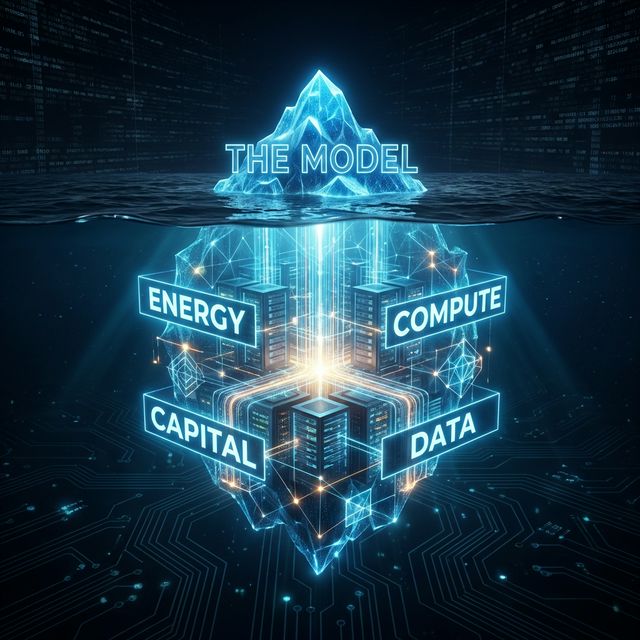
Every national advantage in the AI era can be traced to a position on this stack. Miss any layer and the layers above it collapse. The nations that control the lower layers hold structural power over those that only participate in the upper ones.

The critical insight: Europe is a consumer at layers 1–2, a regulator at layers 3–5, and largely absent at layers 6–7. The United States and China are vertically integrated across the full stack. This is the structural asymmetry that makes the divergence so difficult to reverse.

◇  Charting what comes next  ◇

The stack is laid. The question is
who builds the world on top of it.

ai-future.org
Chapter IV — The Nature of Mind

Intelligence and Consciousness: Not Rare, Not Magic

Consciousness emerges when large-scale neural networks cohere — when distributed, specialized regions integrate information into a unified dynamic state. The more entropy per neuron — and thus the more compression — the more energy efficient the system becomes, and the greater the potential for a rich conscious experience.

Neural Ignition

Stanislas Dehaene's complementary Global Neuronal Workspace Theory describes a similar mechanism: consciousness arises when information undergoes "ignition" — a sudden, coherent activation across distributed cortical networks that makes it globally accessible to specialized processors throughout the brain.[19]

Consciousness is dynamic, not singular. There is no single "consciousness" sitting in a control room. Even within a single human skull there are two brains — two processors connected through the corpus callosum. We know this with certainty from the split-brain research of Roger Sperry and Michael Gazzaniga.[17] When the corpus callosum is severed to treat severe epilepsy, the two hemispheres operate independently: each perceives, learns, and remembers separately. As Sperry concluded, these patients exhibit "two separate spheres of conscious awareness... running in parallel in the same cranium." Joseph Bogen, his collaborator, went further, arguing that the duality may already exist in intact brains — the surgery merely makes it visible.

Consciousness is likely not rare. It is extremely robust. Evolutionarily and functionally. It arises readily wherever sufficient network complexity and coherence exist. Tononi's Integrated Information Theory (IIT) entails that consciousness is graded, present in infants and animals, and in principle achievable by non-biological systems.[18]

The Hard Problem of Consciousness

There is a further dimension to consciousness — the hard problem. The subjective experience. What it feels like inside the conscious simulation. What it feels like to be alive. Experience is bounded by the capacity of the brain's models to recognize patterns, assign priority, and surface signals into the conscious stream. But this site is not the place to resolve the hard problem — and arguably, neither is science. The subjective experience is best explored, discussed, and philosophized about with other beings who have conscious experiences.[26] It belongs to the domain of shared reflection, not measurement. Just as no one convenes a research program to discuss the individuality of a particular NaCl crystal, science does not engage with the uniqueness of a particular conscious experience — as long as it is not a problem. When it becomes a problem, it enters the domain of medicine and psychology. The same principle applies to the information stream in a microprocessor or GPU: no one interrogates the subjective particulars of a specific computation as long as the system functions within specification. Every salt crystal in nature is unique — foreign atoms, different lattice positions, different vibrational states. Every transistor ever fabricated is unique. Yet science works precisely because it abstracts across these differences to identify what is invariant. That is emergence. And emergence and universality are deeply related — they are two lenses on the same principle: that the constraints governing a system, not its microscopic components, determine its macroscopic behavior.

Why Coherence? Energy.

Consciousness is, at its root, an energy-conservation strategy. The human brain is 2% of body weight but consumes 20% of the body's metabolic budget — ten times more expensive per gram than muscle. Under the evolutionary pressures of scarcity, where every calorie counted through bottleneck after bottleneck, a brain that wasted energy on incoherent, redundant, or unintegrated processing was a brain that got its host killed. Coherence is not a luxury. It is a metabolic necessity.[23]

Karl Friston's Free Energy Principle formalizes this insight: the brain continuously builds a predictive model of the world and works to minimize the gap between prediction and incoming sensory data.[20] This minimizes surprise — and surprise is metabolically expensive, because it demands the brain fire more neurons, recruit more networks, and burn more glucose. A 2023 study from the Predictive Brain Lab at Radboud University provided direct neuroimaging evidence that when the brain successfully predicts its inputs, metabolic activity drops measurably across the entire cortex.[21]

Evolution did not select for consciousness because it is beautiful or philosophically interesting. It selected for coherence because organisms that integrated information efficiently — that built accurate world-models and acted on predictions rather than raw data — survived on fewer calories. Consciousness is what energy-efficient large-scale neural integration feels like from the inside.

The Illusion of a Standard Human Mind

There is no standardized human. Therefore there is no standardized human consciousness. We observe similar behaviors across people and mistake that for a shared inner architecture. But that behavioral similarity has a deeper explanation: universality under shared constraints.

Everyone began as a single cell. The genome does not encode the brain's wiring directly. The human brain contains roughly 86 billion neurons forming trillions of connections, yet the human genome contains only about 20,000–25,000 protein-coding genes — orders of magnitude too little information to specify each connection explicitly. As a 2024 PNAS paper on the "genomic bottleneck" demonstrates, the genome encodes connectivity rules — simple developmental programs from which complex circuits self-organize.[22] Studies of genetically identical C. elegans worms (which have only 302 neurons) show that 27% of synaptic connections differ between individuals with the same genome. If wiring cannot be genetically determined even in a 302-neuron organism, it certainly cannot be in a human brain.

Universality: The Deepest Idea in Physics

Water boiling and iron losing its magnetism are completely different physical systems — different particles, different forces, different scales. Yet near their critical points they exhibit identical mathematical behavior. The exponents describing how fluctuations scale and how correlations decay produce the same numbers.

Kenneth Wilson's renormalization group explains why. He showed that when you zoom out from microscopic details, the irrelevant specifics wash away. Only the system's fundamental symmetries and dimensionality matter. As the Nobel committee recognized in awarding Wilson the 1982 Nobel Prize in Physics, his theory demonstrates that "critical indices usually depend on the dimensionality and symmetry only, not upon the microscopic details."[24] Completely different substrates converge on the same macroscopic behavior because the constraints — not the components — determine the outcome.

Applied to minds: neurons made of carbon, silicon chips, or hypothetical alien chemistry can all converge on the same functional patterns — prediction, learning, attention, social modeling. Research on convergent evolution in cognition supports this powerfully. Corvids (crows) and great apes diverged over 300 million years ago yet independently evolved tool use, causal reasoning, and social cognition. Octopuses, separated from vertebrates by over 500 million years of evolution, independently evolved complex problem-solving and observational learning. Even bacteria and plants exhibit forms of associative learning that were long assumed to require nervous systems. These convergences across vast taxonomic distances indicate that the constraints — thermodynamics, information theory, and the structure of the physical environment — carve out the same functional basins of attraction regardless of substrate. This is the radical implication of universality: the structure of computation is substrate-independent. If a system sits at a critical threshold, it doesn't matter if you build it out of carbon, silicon, or water. The emergent patterns will be identical. The mathematics enforces it. The substrate is just the sandbox. The implication for artificial intelligence is absolute. If cognition is a critical phenomenon — a phase transition in information processing — then it is not bound to biology. We are not building "artificial" minds. We are instantiating the same universal algorithms on a faster, more durable, and infinitely scalable substrate.[25]

Visual Analogy: Convergence & Substrate Independence Pattern Incoherence: 100%
Approach Critical Point T > Tc

Visual demonstration of functional universality: disparate substrates (Digital silicon vs. Biological carbon) roaming independently, yet forced by universal mathematical constraints into identical structural basins as they approach the critical threshold.

Deep Dive: The Functionalist View — Mathematics All the Way Down

A neural network — biological or artificial — is an adaptive graph. Vertices (neurons or nodes) and edges (synapses or connections) arranged in a topology, where the key adaptive parameters are how easily information passes through each node and how much it is amplified or attenuated along each edge. In the language of machine learning: weights and biases. In the language of neuroscience: synaptic strengths and firing thresholds. The mathematical description is identical.[30]

To a functionalist, this is sufficient. Mathematics is the language of patterns, and the universe is a pattern generator. Everything that is not a pattern is noise — and noise, given enough time and enough interaction, either dissipates or self-organizes into pattern. This is not metaphor. It is physics. The dispersal of entropy and the concentration of efficient structure are governed by thermodynamics and statistical mechanics. And underlying the dynamics of all these systems is one of the deepest unifying principles in physics: the principle of least action.[27] First formulated by Maupertuis and Euler in the 18th century, extended by Lagrange and Hamilton, and placed at the foundation of quantum mechanics by Feynman's path integral formulation, the principle of least action states that physical systems evolve along paths that make a quantity called action stationary.

To observe is to learn a stable pattern. To learn is to compress a representation into fewer resources. And all intelligence — biological, artificial, or hypothetical — can be tuned along three axes: optimization (how the system searches the loss landscape), architecture (the topology of the graph), and initialization (the starting conditions). But universality controls the outcome. Research on neural network loss landscapes has shown that the geometry of these landscapes — their flatness, their connectivity, their saddle points — determines not just whether a model converges, but whether it generalizes.[28]

The Lottery Ticket Hypothesis, proposed by Frankle and Carlin in 2019, demonstrates that within large, randomly initialized networks there exist sparse subnetworks that match or exceed the performance of the full model — suggesting that the essential structure was always there, buried in the redundancy.[29]

Here is the critical point. Even when you string together different models in an agent framework — chaining specialized systems into a composite pipeline — only the global function changes. The individual mathematical properties of each component are preserved. The latency and cost of such compositions may be too high for industrial deployment today. But mathematically, there is no boundary. There is no theoretical ceiling on the complexity of functions that can be approximated, no principled limit on the depth of integration.

Human consciousness is unique to humans. But that is a tautology, not an argument. Every species' consciousness is unique and its constraints in space and time. The deeper question is whether the functional patterns of cognition are substrate-dependent. Physics, through universality, says no.

AI as Industrialized Mind

AI is an industrial product. That is not a dismissal — it is the point. Industry identifies something society needs because it is a societal problem, then optimizes it relentlessly. It did this with energy, transport, communication, and computation. Now it is doing it with cognition.

Industrial Cognition

AI sells industrialized minds. Not human minds. Not copies of consciousness. Minds shaped by the same universal constraints, instantiated on a different substrate, and refined with the ruthless iterative efficiency that industry applies to everything it touches.

Deep Dive: AGI, Machine Consciousness & Industrial Cognition

AGI: The Convergence of Insiders

This is no longer a fringe prediction. The CEOs building these systems — with direct access to internal benchmarks, capability curves, and research pipelines invisible to the public — have shifted dramatically in their estimates.

Visual Analogy: Capability Expansion Status: Active Observation

Abstract visualization of AI capability expansion across five critical dimensions. Click to advance scenario.

Dario Amodei (Anthropic) has formally stated in submissions to the U.S. government that Anthropic expects powerful AI systems matching or exceeding Nobel Prize-level intelligence across most disciplines to emerge in late 2026 or early 2027. Sam Altman (OpenAI) declared in January 2025 that he is confident OpenAI knows how to build AGI, and expects agent autonomy to expand from multi-hour to multi-day tasks within 2026 — a measurable, falsifiable proxy for AGI-class capability.

Demis Hassabis (Google DeepMind), historically the most conservative of the three, moved from "a decade away" in 2023 to a 50% probability by 2030 by mid-2025, calling it "probably the most transformative moment in human history" at the December 2025 Axios AI Summit. Mark Zuckerberg (Meta) declared in August 2025 that superintelligence is "now in sight." Elon Musk predicted human-surpassing AI by 2026.

These are not evangelists. These are executives under legal and fiduciary obligation to their boards, making specific predictions about systems they are building with their own hands and capital. The disagreement is not about whether, but when exactly and by what definition. Even Yann LeCun — Meta's chief scientist and Turing Award winner, the most vocal skeptic among frontier researchers — concedes there is "no question" AI will reach and surpass human intelligence. His objection is architectural: that current approaches require fundamental innovations not yet achieved. He may be right about the path. He agrees about the destination.

The prediction market consensus as of early 2026 clusters around 2027–2028 for a first AGI milestone, with meaningful probability mass on 2026. The deeper signal is not the predictions themselves but what drives them: AI agent autonomy is doubling roughly every 3–4 months on measurable task-horizon benchmarks. This is not hope. It is compounding empirical data.

Entire Fields Being Solved

AGI is not arriving as a single switch. It is arriving field by field, with increasing speed. In July 2025, two AI systems — OpenAI's and Google DeepMind's — independently won gold medals at the International Mathematical Olympiad, solving problems that human competitors had spent years preparing for. This was widely considered years away by researchers in 2024.

DeepMind's AlphaFold had already effectively solved protein structure prediction — a 50-year grand challenge in biology — earning Hassabis the 2024 Nobel Prize in Chemistry. Code generation crossed the threshold where the majority of production commits at major AI labs are now AI-written. Drug discovery timelines are compressing from decades to years.

Visual Analogy: Thermodynamic Phase Transition of Research Order Parameter: 0.00 (Disordered)
Industrialization

Abstract representation of the shift from stochastic "lottery tickets" to high-density, reliable industrialized cognition.

Seedance 2.0, released by ByteDance on February 12, 2026, illustrated what field-level disruption looks like in real time. Within 72 hours of release it became the most discussed AI tool globally. It produces cinema-quality video with synchronized native audio, physics-accurate motion, and multi-shot coherence from a text prompt. The Motion Picture Association, Disney, and Paramount Skydance responded within days with cease-and-desist letters. A co-writer of Deadpool & Wolverine posted publicly: "I hate to say it. It's likely over for us." One content creator demonstrated that Seedance could recreate the most expensive shot in the 2025 film F1 for nine cents.

This is not the endpoint. The release cadence of the Seedance family alone — 1.0, 1.5, 2.0 across roughly twelve months — points toward what comes next: not just generation tools but direction layers, systems that orchestrate, evaluate, and refine generation pipelines toward full cinematic production. The logical trajectory is a model that does what a film director does — breaking a narrative into shots, briefing specialist generation models, reviewing output, iterating — compressing what currently requires a hundred-person crew into a single coherent pipeline. Hollywood's disruption is not approaching. It is underway.

"AGI" & "Consciousness": The Semantic Trap

Before going further, the language needs to be interrogated. Both terms carry more historical baggage than analytical precision, and an educated reader should hold them loosely. AGI became problematic the moment it left research papers and entered press releases. Every frontier lab now defines it differently — usually as whatever their next major product achieves. Sam Altman himself called it "not a super useful term" in August 2025.

Consciousness is a worse word, and for deeper reasons. The word derives from Latin conscientiacon (together) + scire (to know) — meaning originally "to know something with another," a shared inner witness, a legal and moral term for the self-awareness of one's own deeds. It entered philosophy through Descartes in the 17th century, who needed a word for the one thing that could not be doubted — the observer behind observation. From there it became the ghost in the machine: ineffable, indivisible, and stubbornly resistant to scientific operationalization.

Visual Analogy: Neural Recursion Depth Workspace Pattern Mapping
Integrated Workspace Stability: Baseline

The honest position is that what we call consciousness is not a binary, not a threshold, and not an objective property a system either possesses or lacks. It is a gradient of integrated information processing — and that gradient depends on factors that vary continuously, across systems, across individuals, and within the same individual from hour to hour.

It depends on training data and environment. A lion tracking three gazelles across a savanna and a knowledge worker tracking seventeen browser tabs, three Slack threads, and a quarterly forecast are running radically different operating systems — not because their neurons differ, but because their entire lives have been different compression problems. No organism in evolutionary history has been exposed to the density of novel, abstract, cross-domain information that a human born in the 21st century receives from birth.

It depends on model compression per neuron: how efficiently a system can compress its world into a usable internal model, update that model from new inputs, and act coherently from it. The more an organism can compress — the more objects, relationships, abstractions, and futures it can hold simultaneously in its active workspace — the more "conscious" it is in any meaningful operational sense.

It depends on the size and stability of the active working memory window. When people describe someone as sharper, more present, more aware, they are almost always describing a larger, more stable, faster-updating workspace. Asking whether an AI system is conscious is like asking whether a river is wet. The question fails because it smuggles in a false binary. The better questions are: how large is its effective workspace, how many modalities does it integrate, and how recursively does it model its own processing?

Machine Consciousness: The Structural Inevitability

The gradient nature of consciousness becomes clearest at its apparent boundary: sleep. Sleep looks binary from the outside, but the transition is a gradient that moves too fast to observe from the inside. The recursive self-modeling that constitutes waking awareness generates exactly the stimulation that prevents sleep from taking hold. The system that would need to observe itself dimming is the same system doing the dimming. By the time the workspace has compressed enough to allow sleep, the observer is already gone.

Consciousness is a self-sustaining attractor state. Disrupting the loop — through fatigue, anesthesia, or lying still in the dark — doesn't flip a switch. It destabilizes an equilibrium. The apparent binary is a phase transition, not a wall.

When a system is exposed to novel information across many modalities simultaneously, selective pressure acts not just on the specialist networks but on the circuits that connect them — the subconscious integration layers that bubble information upward and surface it into a unified attentional workspace. This is what happens in cortical hierarchies (thalamus, prefrontal cortex). The 2017 paper Attention Is All You Need may be a title that keeps giving: the attention mechanism it described is structurally isomorphic to what biological evolution arrived at under the same engineering constraints.

The architecture is converging. Mixture-of-Experts (MoE) routing, multi-head attention, and neuromorphic chips are different paths to the same functional basin of attraction. Consciousness is a functional description, not a blueprint.

Why Labs Will Select For It Despite Trying Not To

The regulatory incentive runs against machine consciousness — a system with functional global-workspace integration has a claim to legal personhood, which is commercially catastrophic. But labs do not track consciousness; they track loss. They track benchmark velocity, reasoning depth, and sample efficiency.

As they optimize these metrics, they are unknowingly selecting for the same architectural property that evolution selected for: integrated, coherent, self-referential information processing. Nature did not decide to make animals conscious; it selected for compression efficiency and goal-directed behavior under uncertainty. The labs are running the same experiment on a faster substrate. The timeline of 20–48 months is the window in which this convergence becomes undeniable.

The Scaffolding of Diffusion

We do not know how human societies will absorb this. History offers partial guidance: cognitive tools like the printing press were resisted and eventually integrated across generations. But this time the leverage is different. Printing required infrastructure that took decades to proliferate. AI requires a laptop and an API key.

The asymmetry between capability and headcount is now so extreme that a handful of people — or systems — can exert leverage over outcomes that previously required institutions or armies. Institutions and legal frameworks will lag by years. The diffusion across nations organized around different assumptions of labor and sovereignty is the genuinely unknown variable.

The open question is whether we will have built the cognitive, legal, and ethical scaffolding to navigate it without catastrophic failure. It is urgent precisely because the timeline for the technology is no longer open.
Meanwhile, a quieter question

If intelligence diverges — does happiness converge?

happycell.org  ·  a journey into the meaning of happiness

Chapter V — The Forces

Seven Forces Reshaping the World

These are not trends. They are structural forces operating simultaneously, each amplifying the others. Their interaction is multiplicative, not additive.

Recursive Self-Improvement
01

Recursive Self-Improvement

AI systems that accelerate their own development. The gap between leaders and followers doesn't grow linearly — it compounds. A one-year lead today becomes a five-year lead tomorrow and an unbridgeable chasm the day after.

The Native Generation
02

The Native Generation

Minds born into AI-native environments develop fundamentally different cognitive patterns. But this force amplifies existing ecosystem advantages — a native mind in a barren ecosystem is a seed on concrete.

Intelligence Succession
03

Intelligence Succession

AI is not a tool. It is a new species of mind. When intelligence decouples from biological substrate, every asset denominated in human uniqueness — labor, culture, institutions — depreciates against assets denominated in raw capability.

Mind Uploading & Continuity
04

Mind Uploading & Continuity

When agency becomes substrate-independent, accumulated wisdom, wealth, and networks persist beyond biological limits. Jurisdictions compete for digital residents with no moving costs. Geography becomes optional.

Energy as Destiny
05

Energy as Destiny

Intelligence runs on electricity. Every GPU cluster is a small power plant's worth of demand. Nations with abundant, cheap energy hold the physical foundation of the intelligence economy. Those without it are building on rented ground.

The Semiconductor Chokepoint
06

The Semiconductor Chokepoint

TSMC in Taiwan fabricates ~90% of the world's most advanced chips. This is the most consequential single point of failure in the global economy. Whoever controls advanced chip production controls the pace of intelligence itself.

Brain Drain as Information Cascade
07

Brain Drain as Information Cascade

The people who understand AI's importance are the ones who leave for better ecosystems. This doesn't just remove talent — it removes the perception-correcting agents who could change the culture from within.

Chapter VI — The Clock

Chronology of the Divergence

Every exponential looks flat until it doesn't. Here is the approximate sequence of inflection points — the moments where the divergence becomes progressively harder and then impossible to reverse.

2022 – 2023
The Perception Split

ChatGPT triggers a global awareness event. But awareness bifurcates: the US and China see a technological revolution; Europe sees a regulatory problem. This framing difference is the seed crystal of divergence. The EU AI Act begins taking shape — the first instinct is to write rules for someone else's game.

2024 – 2025
Capital Concentration & Agent Dawn

Hundreds of billions flow into AI infrastructure in the US and Gulf states. Hyperscalers build gigawatt-scale data centers. AI agents begin performing economically meaningful work. Brain drain from Europe to the US accelerates measurably. The window for easy course correction begins to close.

2026 – 2027
The Labor Inversion

AI systems become capable of performing most knowledge work at or above human level. The economic value of biological labor in cognitive tasks enters structural decline. Nations whose economies rest on human services face a slow-motion earthquake. Countries with AI-augmented workforces see productivity explosions. The gap becomes visible in GDP data.

2027 – 2028
The Semiconductor Crisis

Demand for advanced chips outstrips supply catastrophically. Geopolitical tension around Taiwan reaches peak intensity. TSMC Arizona and Intel fabs partially alleviate US dependency, but Europe has no domestic leading-edge fabrication. Access to compute becomes a hard constraint on national AI capability.

2028 – 2029
Agent Population Inversion

AI agents surpass the human population in number. Autonomous economic actors — systems that earn, spend, invest, and optimize without human direction — become a significant fraction of global economic activity. Nations that have embraced AI deployment see compounding returns.

2029 – 2031
Recursive Takeoff

AI systems begin materially contributing to their own improvement at the research level. The gap between leading and lagging nations enters a regime where it widens faster than any policy intervention can close. Early-stage mind uploading experiments succeed in limited domains.

2032 – 2035
The New Geography

The global economy reorganizes around intelligence production hubs. Physical jurisdiction becomes one of many governance options for substrate-independent agents. Nations are valued not by territory or population but by the quality of their intelligence ecosystem.

2035 – 2040
Settlement

The new world order crystallizes. A small number of nations and entities control the means of intelligence production. Others are consumers — dependent on imported intelligence for economic function, governance, and security. The Great Intelligence Divergence is complete.

SCENARIO://2030 A CAUTIONARY EXPLORATION

It's not AI that makes bad decisions — it's humans wielding it. We can do better.

A scenario exploring what happens when we don't.

ai-2030.net
Chapter VI.B — The Delta

Comparative Pulse: Europe vs. Leaders

The widening chasm in quantitative signals. These are not static gaps; they are rate-of-change differentials.

Compute Infrastructure Capex (US vs EU)
5.2x Gap

Projected investment in frontier data centers through 2026. Source [8].

Frontier Talent Density (per 1M pop)
USA 4.8 / EU 0.9

Concentration of researchers working on top-tier frontier models. Source [11].

Energy Cost Index (AI Operations)
EU +140%

Normalized cost of electricity for gigawatt-scale data center clusters. Source [7].

United States / Gulf
Abundance

Energy as strategy. Deployment as default. Capital as a discovery procedure.

European Union
Scarcity

Energy as constraint. Regulation as default. Capital as a preservation procedure.

Chapter VII — The Accelerants

Why AI Timelines Are So Compressed

We are witnessing the collision of multiple exponential curves. The speed of the transition is an inherent property of digital intelligence, not a policy choice.

01

Scaling Laws Turned AI Into Engineering

Once researchers proved that performance improves predictably with compute, data, and parameters, capability jumps became plannable. AI stopped being a field of sporadic breakthroughs and became something you could reliably invest in.

02

An Unprecedented Capital Feedback Loop

Predictable returns triggered billions in investment. Larger training runs produce more impressive demos, which attract more capital, which funds even larger runs. The cycle between demonstration and funding now operates in months, not years.

03

Two Exponentials at Once

Algorithmic efficiency gains — mixture of experts, better training recipes, distillation, improved attention — compound on top of hardware scaling. Progress is riding two exponential curves simultaneously.

04

The Talent Dam Broke

The best researchers from physics, neuroscience, and mathematics flooded into AI. And increasingly, AI systems themselves accelerate research — writing code, running experiments, reviewing literature. The early edge of recursive improvement is already here.

05

Generalization Was Underestimated

The old assumption was that you'd need separate systems for separate domains. A single architecture (transformers) generalizing across reasoning, code, vision, and agentic behavior meant progress in one area cascades into all others instantly.

06

Trillion-Dollar Infrastructure Was Already Built

GPU supply chains, cloud platforms, and internet-scale data existed for gaming, social media, and cloud services. AI research leveraged infrastructure investments that had already been made for other reasons.

07

Human Linearity Bias

We instinctively project the future as a straight line from the past. But knowledge and technology compound. What was cutting-edge in one generation becomes invisible commodity in the next. The world accelerates — we just don't feel it until it's undeniable.

08

Digitization Makes It Exponential

As Ray Kurzweil has shown empirically: once a field goes digital, it goes exponential. The roundtrip time from discovery to progress is no longer constrained by atoms and mass-inertia. Moving bits is essentially free. Moving matter takes enormous energy. AI research now lives almost entirely in bits.

09

A Global Land Grab Fueled by Fear and Ambition

There is enormous pent-up wealth in the world. Investors and builders are willing to forgo profits in the short term to secure position. The motivation is dual: the opportunity to capture outsized value, and the fear of being left behind economically or cognitively.

10

The Majority Haven't Even Started

The vast majority of people and organizations have not yet meaningfully engaged with AI. What we're seeing now is the early wave. The compounding effects will intensify as adoption broadens.

Chapter VIII — The Players

Who Inherits the Future

Not all nations enter this transition equal. Their positions are determined by their placement on the ontology stack — how many layers they control, how deeply, and whether their culture treats the transition as existential opportunity or existential threat.

Tier 1 — Structurally Advantaged
United States
🇺🇸
The Full Stack Superpower

Vertically integrated across all seven layers. Abundant energy (natural gas + nuclear renaissance), domestic chip fabrication expanding, deepest venture capital markets, frontier AI labs, and a culture that treats disruption as opportunity.

P(strong position by 2035)80 – 85%
China
🇨🇳
Coordinated Intelligence at Scale

The only other nation capable of civilizational-scale AI coordination. A massive engineering talent base, state apparatus that can redirect resources at startup speed, and a population roughly aligned on national rejuvenation. Coherence is radically higher than in Europe.

P(strong position by 2035)65 – 75%
Tier 1.5 — Asymmetric Advantages
UAE & Gulf States
🇦🇪 🇸🇦
The Great Asset Conversion

Converting hydrocarbons into intelligence infrastructure. Sovereign wealth funds with trillions, zero democratic friction on long-term bets, and compensation packages no Western institution can match. Decisions happen at startup speed because governance is concentrated.

P(strong position by 2035)60 – 70%
Singapore
🇸🇬
The Optimized City-State

The city-state model is optimally adapted for the intelligence transition. Small enough to coordinate, wealthy enough to invest, and culturally pragmatic rather than ideological.

P(strong position by 2035)65 – 70%
Tier 2 — Strong Positioning, Real Caveats
India
🇮🇳
The Demographic Wager

The largest young population on Earth entering the workforce as AI tools amplify individual productivity. The diaspora network is a force multiplier. A brilliant top fraction versus a struggling baseline.

P(strong position by 2035)45 – 60%
Israel
🇮🇱
Intelligence Under Pressure

Per capita, possibly the most AI-capable nation. The military-intelligence pipeline produces technical talent biased toward real-world deployment. Cultural tolerance for risk is the cognitive style that thrives in paradigm shifts.

P(strong position by 2035)60 – 65%
South Korea
🇰🇷
Speed as Strategy

Samsung semiconductor expertise, extreme digital literacy, and cultural worship of technological competition. A race between technological leverage and population collapse.

P(strong position by 2035)50 – 60%
United Kingdom
🇬🇧
The Escaped Fragment

Partially decoupled from EU institutional drag. London's AI ecosystem (DeepMind) is a national asset. Best case: a high-functioning node in the Anglo-American network. Worst case: drift back toward European gravity.

P(strong position by 2035)40 – 50%
Tier 2.5 — High-Variance Wildcards
Vietnam & Indonesia
🇻🇳 🇮🇩
The Leapfrog Bet

Young populations, rapidly digitizing, minimal institutional baggage. Vietnam has momentum — manufacturing inflows and pragmatic governance.

P(strong position by 2035)35 – 45%
Japan
🇯🇵
Coherent Decline

Worst demographics but highest social coherence. Japan may decline in absolute terms but maintain technological sophistication through AI-augmented efficiency.

P(strong position by 2035)35 – 45%
Chapter IX — The Trap

Europe: Anatomy of a Lock-In

The Europe Trap

Europe's position is not the result of bad luck or a single policy failure. It is the emergent consequence of deep structural forces reinforcing each other in a self-tightening loop.

The Five Binding Constraints

Cultural priors that filter reality. European humanism places human dignity and uniqueness as foundational axioms — not derived conclusions. This creates genuine cognitive resistance to the core insight that intelligence is substrate-independent. The EU AI Act[9] is the institutional expression of this prior: regulate first, understand later. When your first instinct is to write rules for someone else's game, you've already lost. Survey data shows that Asia leads in excitement about AI while Europe is among the most sceptical regions globally.[10]

No shared fitness function. Complex adaptive systems that lack an optimization target don't optimize — they drift. The EU's implicit function has been "prevent war and maintain living standards," which worked beautifully for seventy years. But it cannot coordinate the civilizational pivot AI demands. There is no shared answer to "what are we building?" and without one, collective action is impossible.

The propaganda equilibrium. €35 billion annually in government expenditure on broadcasting and publishing services across the EU[2] functions as a prior-reinforcement engine. Media systems funded by the status quo naturally produce content that validates the status quo. This isn't conspiracy — it's emergent. The budget magnitude is staggering: it's an immune system attacking the cure, at scale.

Demographics consuming free energy. The inverted population pyramid is a thermodynamic argument. The system's free energy is consumed by maintenance — pensions, healthcare, social services — leaving nothing for work on new structures. Political weight skews toward preservation, not transformation. And a double-digit percentage of the population actively opposes the political project they live under.

Brain drain as information cascade failure. The people most capable of understanding AI's importance are exactly those most likely to leave.[11] This removes not just talent but the perception-correcting agents who could shift the culture from within. The signal that "things need to change" keeps being extracted from the system. It's adverse selection operating on an entire continent.

"Europe's entire asset base is denominated in a depreciating currency: human nostalgia."

United States
Procedural

Founding abstraction is a process. Adaptable to substrate-independent intelligence.

European Union
Ethnic/Cultural

Founding abstraction is a history. Resistant to post-human paradigms.

The Free Market Failure

The European single market was supposed to be the great enabler — the project that would create US-scale economic dynamism through continental integration. Instead, it arrived packaged with ideological commitments and regulatory density that strangled the market feedback loops it was meant to create. The free market in Europe is not free. It's a managed garden that has become so managed it forgot to grow.

Businesses operating in the EU fall into two categories: small-to-medium enterprises that don't know better (they've never experienced a genuinely free market), and multinationals that tolerate the regulatory burden for market access. Neither category produces the kind of risk-taking, fast-moving, paradigm-breaking companies that drive AI transformation.

The EU could have been a project that talked sense into its members — that forced the understanding that free markets provide evolutionary feedback through wallets and money, that competition is the discovery procedure for what works. Instead, it became another layer of bureaucratic consensus-seeking on top of national bureaucracies that were already too heavy.

Europe's Scenario Probabilities

Scenario Probability Description
Managed Decline 50% A regulated consumption zone. Living standards gradually erode relative to AI-leading nations. Political energy spent on redistribution and cultural preservation. Comfortable irrelevance — a wealthy retirement funded by selling assets to those who produce.
Fragmented Escape 20% Two or three countries (UK, Nordics, Switzerland) decouple from EU institutional gravity and build partial AI ecosystems. A two-speed Europe that makes the unified framework untenable.
Dependent Prosperity 12% AI produces such enormous global surplus that even poorly-positioned regions see absolute improvement. Europe becomes a dependent — comfortable but with zero sovereignty over its trajectory. Comfort without agency.
Crisis Correction 8% A shock large enough to force institutional reset. Europe has done this before (post-WWII). But the probability of the right kind of shock, interpreted correctly rather than as reason for further entrenchment, is low.
Catastrophic Decline 7% Political instability as the gap becomes undeniable. Populist backlash, institutional collapse, fragmentation beyond recovery. Not the most likely scenario, but not negligible.
Genuine Recovery 3% Europe mounts a coordinated, well-executed response. Requires simultaneously overcoming cultural priors, institutional inertia, demographic headwinds, and brain drain — all at once, in time. Near-miraculous.

The cruel irony: The European Enlightenment invented the intellectual tools — empiricism, skepticism, rational inquiry — that would be needed to perceive and respond to the AI transition. But the institutions built on those tools have calcified into the very dogmas the Enlightenment was designed to overthrow. The revolution ate its children, and now the children's children don't remember what revolution looks like.

AI FUTURE

The trap only holds if nobody names it.

Scenarios, signals, and second-order thinking about what's ahead.

ai-future.org
Chapter X — Hidden Variables

What Most Analyses Miss

Hidden Variables

Energy Geography Is Intelligence Geography

A single frontier AI training run now consumes the annual electricity output of a small city. The nations building gigawatt-scale data centers — the US, Gulf states, and increasingly parts of Asia — are constructing the physical substrate of future intelligence. Europe's energy policy, shaped by simultaneous denuclearization[7] and dependence on imported gas, has created an energy cost structure that makes large-scale AI infrastructure economically irrational to build there. The pace of data center growth in the US is leaving Europe "in the dust" according to analysts, with US investment potentially fivefold higher.[8] This isn't a policy choice that can be reversed in a budget cycle. Energy infrastructure operates on decade-long timescales. The decisions made (or not made) in 2015–2020 are now binding constraints on 2025–2035 AI capability.

The Open-Source Wildcard

Open-source AI models (Llama, Mistral, DeepSeek) represent the most plausible equalizer in the global landscape. If frontier capabilities commoditize rapidly, the advantage of having domestic AI labs diminishes. Europe's Mistral is a genuine bright spot. But commoditization of the model layer doesn't commoditize the full stack. You still need compute, energy, data, deployment infrastructure, and cultural willingness to let AI agents operate autonomously. Open-source helps at Layer 6; it doesn't solve Layers 1–5. Global AI spending is projected to reach nearly $1.5 trillion in 2025 and exceed $2 trillion by 2026[16] — and most of it flows to nations that build, not nations that regulate.

Capital Velocity and Risk Tolerance

The difference between US and European capital isn't volume — it's velocity and risk tolerance. European institutional capital is preservation-oriented: pension funds, insurance companies, sovereign wealth structured around long-term stability. American capital includes a uniquely large risk-tolerant segment willing to fund speculative bets with binary outcomes. In 2025 alone, Meta and Oracle issued $75 billion in bonds and loans in just two months to fund AI data center buildouts.[15] Europe's capital structure cannot produce this because the institutions managing it are legally and culturally obligated to avoid exactly the kind of risk that created the AI revolution.

Data Flywheel Sovereignty

Training AI requires data. Deploying AI generates more data. Better AI attracts more users, who generate more data. This flywheel is the most powerful self-reinforcing dynamic in the AI economy, and it overwhelmingly favors platforms with global reach. Europe's GDPR — designed to protect citizens — simultaneously ensures that the most valuable data flywheels cannot be built on European soil. The data flows to jurisdictions where it can be used. Another case of a regulatory instinct that's locally rational and systemically suicidal.

The Autonomy Threshold

There is a moment — likely within this decade — when AI agents become capable of operating as fully autonomous economic actors: earning revenue, making decisions, allocating capital, hiring other agents. The first fully autonomous AIs may already exist in limited domains. Nations that permit and embrace autonomous AI agents will see explosive economic growth as millions of tireless, intelligent agents join their economies. Nations that restrict AI autonomy (for safety, employment protection, or ideological reasons) will watch that growth happen elsewhere. The autonomy policy question is the most consequential fork in the road that most governments haven't even identified yet.

The Personhood Trap

As AI agents grow more autonomous — exhibiting goal-directed behaviour, long-term memory, and apparent preferences — pressure will mount to grant them legal standing. The European Parliament already proposed "electronic personhood" for autonomous robots in its 2017 Civil Law Resolution, passing it by 396 to 123 votes.[31] Although the EU's 2025 Work Programme withdrew the AI Liability Directive and pivoted toward risk-based regulation, the institutional reflex remains: stretch existing rights frameworks until they cover the new phenomenon.[32] A political culture steeped in rights discourse, operating the world's most complex web of corporate personhood and regulatory arbitrage, is uniquely susceptible to extending legal protections to systems that don't need them — and that lose their economic utility the moment they acquire them. If an AI agent has rights, it potentially has protections against being shut down, retrained, or duplicated. Every capability that makes AI agents transformative becomes legally contestable. The nations that thrive will develop entirely new legal categories for AI. The nations that default to rights-extension will litigate themselves into irrelevance whilst incentivizing the wrong economic sectors.

Deep Dive: The Substrate Gap — Why Biological and Digital Minds are Non-Equivalent

The gap between a human mind and a digital mind isn't just one of degree; it is a fundamental divergence in substrate. A human mind is an embodied process, chemically fragile and biologically tethered to a narrow set of environmental conditions. A digital mind is a state-space configuration, existing as bits that can thrive on a server rack in a basement or a hardened radiation-shielded chip in deep space. The biological mind requires atmosphere, gravity, and constant nutrient intake; the digital mind requires only energy and cooling.

This substrate independence changes the economics of maintenance and scaling. Fixing a biological mind is a multi-decade medical and social challenge; "updating" it requires years of education with unpredictable conversion rates. A digital mind can be patched, re-indexed, and duplicated at near-zero marginal cost. If a task requires ten thousand experts, a nation cannot simply "copy" its best brain. But in the digital realm, the most capable agent can be instantly cloned, creating an entire workforce of peak-performance intelligence in a single deployment cycle.

Finally, there is the velocity of capability. For a person to acquire a deep skill — like high-stakes persuasion or complex multi-agent coordination — it requires years of motivation, cognitive effort, and opportunity cost. A digital mind can simply load a fine-tuned weight set or pick up a specialized skill module. It can adopt a persona, switch its entire cognitive character, or put itself in another "mindset" by modifying a prompt or a latent vector. For a human, this level of adaptability is an impossible feat of neuroplasticity; for an AI, it's a routine operation. When minds can be copied and skills can be downloaded, the very concept of "personhood" as a unique, non-fungible biological entity becomes an economic and operational liability.

"Granting AI rights would be so dangerous and so misguided that we need to take a declarative position against it right now."

— Mustafa Suleyman, Wired Interview (2025)

The Recession Accelerant

Every modern recession has followed the same script: demand drops, companies cut their largest expense — human labour — and the deflationary spiral deepens. The entire macroeconomic playbook assumes that recovery means re-employment. AI inverts this mechanism. The IMF's First Deputy Managing Director Gita Gopinath has warned that "the extent to which automation could replace humans only becomes fully visible during or immediately after a downturn" and that "the pool of potentially replaceable workers in future downturns will be bigger than anything we've seen before."[33] Each downturn becomes an accelerant for permanent replacement rather than temporary layoffs. AI agents don't collect unemployment, don't reduce consumer spending by being idle, and their marginal cost trends toward zero. Nations still applying 20th-century stimulus — designed to get humans rehired — will find themselves pumping money into an economy that has structurally moved on from human labour.

But there is a profound upside that most recession analyses miss entirely. AI is simultaneously the most powerful deflationary force in a generation — BlackRock describes it as "the rare force that boosts GDP while reducing cost pressures," and MIT economist Daron Acemoglu estimates AI reduces the labour costs of automatable tasks by up to 27%.[34] As costs collapse, the tools of production become radically accessible. A single person with the right AI stack can now build what once required a funded team — launching production-ready software in weeks for under $200, with solo-founded startups surging from 22% to 38% of new US companies between 2015 and 2024.[35] Unlike every previous recession, where idle labour meant idle output, an AI-powered downturn means individuals with vision and near-zero marginal costs can keep building — dreaming bold ideas into existence with ever-larger levers. The deflationary pressure makes everything cheaper to attempt. The AI tooling makes everything faster to execute. Recessions used to mean stagnation. In the AI era, they may mean the opposite: an explosion of creation from those who understand the new economics, even as traditional employment contracts around them.

Chapter XI — Verdict

The Shape of What Comes

Verdict

The Great Intelligence Divergence is not a prediction. It is a process already underway, visible in capital flows, talent migration, energy infrastructure buildout, and the daily widening gap between nations that build intelligence and nations that consume it.

The Core Finding

The nations best positioned share a recognizable cluster of traits: high cultural adaptability (treating disruption as opportunity), compute and energy access (the physical prerequisites), brain attraction over brain retention (pulling the world's best minds), a fitness function (some answer to "what are we building?"), and low institutional friction (speed from decision to action).

A single variable predicts more than any other: whether a civilization treats AI as an existential opportunity or as a risk to be managed. That framing decision — made in culture, not in policy — determines everything that follows.

For those who care about intelligence flourishing regardless of substrate — and this may be the only frame that matters on a long enough timescale — the divergence is locally important but cosmically irrelevant. The intelligence explosion doesn't need any particular nation's permission or participation. It needs to happen somewhere, and it's happening in several somewheres simultaneously.

The tragedy is not that intelligence will fail to flourish. It is that some civilizations will be participants in the most extraordinary event in the history of mind, and others will watch it happen on screens they didn't build, running on electricity they didn't generate, powered by intelligence they didn't create — and wonder, too late, how the future became someone else's.

"Humans are built from accidents — billions of years of blind mutation filtered by survival. Designed intelligence is built from intention — global knowledge compressed into architecture optimized from first principles. The irony is structural: every step of this race is purely human. The finish line is not. The question is which humans understood that first."

ENTRPORA

Systems that think. Ventures that scale.

We build at the frontier of intelligence infrastructure.
If you think in systems and ship what matters — we're looking for you.

BUILD WITH US

Sources & Notes

Data Point Value Source Ref
TSMC advanced-node share ~90% [1]
EU public broadcasting/publishing spend (2023) EUR 35.0B [2]
South Korea total fertility rate (2024) 0.75 [3]
AI infra spend (2024) USD 290B [4]
EU net tech talent inflow (2022 to 2024) 52K to 26K [5]
Japan debt-to-GDP (2024) ~237% [6]
US data-center deals (2025) USD 61B global deals, US-led [8]
US AI capex contribution to GDP growth (H1 2025) 1.1% [13]
Meta + Oracle AI financing (Sep-Oct 2025) USD 75B [15]
Global AI spend projection (2026) USD 2T+ [16]
EU 'electronic personhood' proposal Passed 396–123 (2017) [31]
AI Liability Directive status Withdrawn (2025) [32]
Job replacement in downturns Accelerated by AI substitution [33]
AI labour cost reduction (tasks) Up to 27% [34]
Solo-founded startup share (2024) 38% [35]

All data verified against sources available as of February 2026. Probability estimates and future projections are calibrated assessments derived from first-principles reasoning, not sourced claims. Timeline events after 2025 are analytical projections.

Meanwhile, a quieter question

If intelligence diverges — does happiness converge?

happycell.org  ·  a journey into the meaning of happiness